


Sometimes, the most powerful innovation doesn’t come from building something new, but from seeing existing assets in a new light.
In South Africa, families and governments faced a dilemma: nearly one-third of three- to five-year-olds lacked access to high-quality early education that could transform the trajectory of their lives, yet the traditional solution—capital-intensive formal learning centers—are unrealistic in the communities that need them most.
So, what to do?
Under the leadership of Founding CEO Grace Matlhape, 2026 Skoll Awardee SmartStart designed a model to leverage existing community assets to tackle the problem. Low-income communities have plenty of physical spaces, such as homes and community centers, and they’re bursting with local talent and capacity.
In recognition of these opportunities, SmartStart equipped thousands of community members, most of whom are women, to operate early learning centers out of their homes and similar spaces—closing the learning achievement gap for children while, at the same time, creating dignified, high-quality careers in areas plagued by high unemployment.
Here’s how they did it:
What sets the innovation apart is the organization’s so-called social franchise model, in which SmartStart provides training, materials, coaching, compliance support, and peer networks to franchisees via a single platform. This approach addresses two persistent challenges simultaneously: affordability of care, and economic instability for communities. It’s an elegant solution that is easily scalable nationwide.
In some of South Africa’s informal settlements and marginalized townships, jobless rates can climb as high as 60–70 percent, and young children who live there are undercounted and overlooked. These families simply fall through the cracks.
Yet the national government has declared a goal of ensuring universal early education access by 2030. SmartStart’s social franchise model is an affordable way to achieve that stated ambition.
“We have to solve for those children,” Matlhape says. “It isn’t possible to wish there was a piece of land where you could build a center. …You have to work with what you have.”
The SmartStart team is vocal about their role in a broader ecosystem of actors engaged in collective action to create lasting change within South Africa’s educational and economic systems. The organization’s deep partnership with the government is paramount to the viability of the model. They’ve worked together to shift attitudes about what quality early education programs can look like, amend regulations to support home-based learning, and collaborate on shared goals related to increasing access.
After establishing program delivery infrastructure in all nine South African provinces—reaching more than 160,000 children every week—SmartStart is now focusing on building broader partnerships to enable even more access, including implementing systems, advocating for policies, and disseminating lessons to support continued expansion of early learning. These steps are extending the organization’s impact far beyond its delivery footprint.
But success is not all about growth, infrastructure, and systems. SmartStart underscores the importance of a heart-led approach when working with children; it’s an ingredient as essential as the robust curriculum.
All practitioners in the SmartStart network emphasize three things: love, play, and talk. These values are elevated not only because it’s the right thing to do, Matlhape said, but also because it garners “the outcomes we’re looking for.”
And it’s working. Children in SmartStart’s programs demonstrate significant improvements in math, literacy, and fine motor skills. The percentage of children who are “on track” across five developmental domains increased from 45 percent to 65 percent in just eight months, while the proportion of children “falling far behind” was nearly halved.
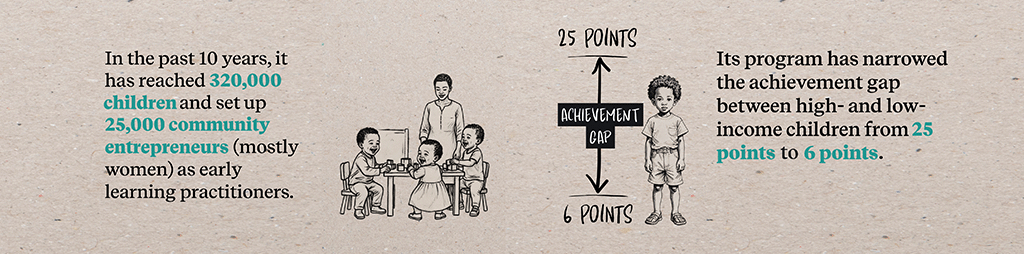
Ultimately, children who receive high-quality early education are better prepared for formal schooling, are more likely to complete secondary education, and are more likely to secure meaningful and financially stable careers as adults.
Beyond children, the ripple effects of SmartStart’s program on communities’ economic development are profound. In addition to gaining greater financial security for themselves, early learning practitioners often employ several additional community members. And, with their children in reliable care, parents are able to focus on their own livelihoods.
Learn more about how SmartStart is creating opportunity across generations of South Africans.

